
Amazon FBA Storage Fee Calculator (2026 rates, US & UK)
Calculate Amazon FBA storage fees for any product: monthly storage, Q4 peak rates, the aged inventory surcharge and the storage utilization surcharge – plus the new February 2027 US age-based rates. Then check profit and ROI in the same place.
Rates verified against Amazon’s published fee pages on November 9, 2026.
Estimated storage fees for the period
$220.00
- Per unit (whole period)
- $2.20
- Per unit per month
- $0.37
- Cubic feet per unit
- 0.278
- Size tier
- Standard-size
- Q4 peak share
- $133.33
- Aged inventory
- $0.00
Assumes the same number of units stays in storage all period (no sales). Non-dangerous goods.
Month-by-month breakdown
| Month | Rates | Age | Base | Aged | Util. | Total |
|---|---|---|---|---|---|---|
| Nov 2026 Q4 peak | 2026 | 15 | $66.67 | $0.00 | $0.00 | $66.67 |
| Dec 2026 Q4 peak | 2026 | 45 | $66.67 | $0.00 | $0.00 | $66.67 |
| Jan 2027 | 2026 | 75 | $21.67 | $0.00 | $0.00 | $21.67 |
| Feb 2027 | 2027 unified | 105 | $21.67 | $0.00 | $0.00 | $21.67 |
| Mar 2027 | 2027 unified | 135 | $21.67 | $0.00 | $0.00 | $21.67 |
| Apr 2027 | 2027 unified | 165 | $21.67 | $0.00 | $0.00 | $21.67 |
Profit per unit
–
- ROI
- –
- Margin
- –
- Referral fee
- –
- Total Amazon fees
- –
- Sales VAT
- –
- Cost VAT reclaimed
- –
The ProductPanel extension fills in the real referral fee and FBA fee for the product you are looking at, converts your cost from your own currency and remembers your VAT settings.
How Amazon FBA storage fees are calculated
Amazon charges storage every month for the space your inventory takes up in its fulfillment centers:
Storage fee = average daily units × cubic feet per unit × monthly rate
Cubic feet per unit = length × width × height of the packaged item in inches ÷ 1,728 (in centimetres ÷ 28,317). Amazon uses its own measurements of the packaged unit – check them in Seller Central if your fees look too high. The rate depends on three things:
- Size tier – standard-size items pay more per cubic foot than oversize items.
- Time of year – October to December is peak season with much higher rates.
- Inventory age – units stored more than 180 days (US) or 240 days (UK) pay extra.
Example
A product in a 12 × 10 × 4 inch box is 0.278 cubic feet. Storing 100 standard-size units in the US costs 100 × 0.278 × $0.78 = $21.67 per month from January to September, and 100 × 0.278 × $2.40 = $66.67 per month from October to December.
Q4 storage fees (October – December)
Peak-season storage costs about three times more in the US ($2.40 vs $0.78 per cubic foot for standard-size items) and about twice as much in the UK (£1.51 vs £0.76). Plan Q4 inventory so it sells through by December: everything still in a fulfillment center during October–December is billed at the peak rate, and from February 2027 US stock that ages past 180 days pays much more.
What changes on February 1, 2027 (US)
Amazon announced on November 5, 2026 that it will remove the storage utilization surcharge and fold the aged inventory surcharge into a single age-based monthly rate – the unified monthly storage fee. In practice:
- Stock younger than 180 days keeps the same rate: $0.78 per cubic foot for standard-size items (January–September).
- Stock aged 181–270 days jumps to $2.78, and 271–365 days to $6.68 per cubic foot.
- Clothing, shoes, bags, jewelry and watches now pay age-based rates too, at a reduced level for 181–270 days.
- Sellers who build stock before Prime Day or Q4 no longer pay a utilization surcharge.
The calculator above switches to the 2027 rate card automatically for months from February 2027 – set the first month and the number of months to compare.
How to reduce FBA storage fees
- Send smaller, more frequent shipments instead of one large one.
- Avoid sending slow-moving stock right before October.
- Remove, liquidate or discount units before they reach 181 days (US) or 241 days (UK).
- Reduce packaging size – a smaller box means fewer cubic feet every month.
- Check sales velocity with a BSR history chart before reordering, and check competitors’ stock levels to avoid buying more than the market can absorb.
Amazon FBA storage fee rates
US monthly storage fees 2026 (per cubic foot)
| Size tier | January – September | October – December |
|---|---|---|
| Standard-size | $0.78 | $2.40 |
| Oversize (bulky, extra-large) | $0.56 | $1.40 |
US aged inventory surcharge (until January 31, 2027)
Charged monthly on top of storage fees, based on an inventory snapshot on the 15th.
| Inventory age | Surcharge |
|---|---|
| 181–210 days | $0.50 / cu ft* |
| 211–240 days | $1.00 / cu ft* |
| 241–270 days | $1.50 / cu ft* |
| 271–300 days | $5.45 / cu ft |
| 301–330 days | $5.70 / cu ft |
| 331–365 days | $5.90 / cu ft |
| 366–455 days | $6.90 / cu ft or $0.30 / unit, whichever is greater |
| 456+ days | $7.90 / cu ft or $0.35 / unit, whichever is greater |
* Clothing, shoes, bags, jewelry and watches are excluded from the 181–270 day tiers.
US storage utilization surcharge (until January 31, 2027)
Added per cubic foot to inventory older than 30 days when your storage utilization ratio is above 22 weeks.
| Utilization ratio | Standard-size | Oversize |
|---|---|---|
| 22–28 weeks | $0.44 | $0.23 |
| 28–36 weeks | $0.76 | $0.46 |
| 36–44 weeks | $1.16 | $0.63 |
| 44–52 weeks | $1.58 | $0.76 |
| 52+ weeks | $1.88 | $1.26 |
US unified monthly storage fee from February 1, 2027
One age-based rate replaces the monthly fee, the aged inventory surcharge and the storage utilization surcharge. Rates below are January–September; from October to December add $1.62 (standard-size) or $0.84 (oversize) per cubic foot.
| Inventory age | Standard-size | Bulky & oversize |
|---|---|---|
| 0–180 days | $0.78 | $0.56 |
| 181–270 days | $2.78 (apparel $1.78) | $2.56 (apparel $1.56) |
| 271–365 days | $6.68 | $6.46 |
| 366–455 days | $7.68 or $0.78 + $0.30/unit | $7.46 or $0.56 + $0.30/unit |
| 456+ days | $8.68 or $0.78 + $0.35/unit | $8.46 or $0.56 + $0.35/unit |
Per-unit alternatives apply when greater. Apparel = clothing, shoes, bags, jewelry and watches.
UK monthly storage fees 2026 (per cubic foot)
| Product type | January – September | October – December |
|---|---|---|
| Standard-size, most categories | £0.76 | £1.51 |
| Standard-size clothing, eyewear, footwear, rucksacks & handbags | £0.62 | £0.82 |
| Oversize | £0.55 | £0.87 |
UK aged inventory surcharge
| Inventory age | Surcharge |
|---|---|
| 241–270 days | £1.18 / cu ft* |
| 271–300 days | £3.14 / cu ft |
| 301–330 days | £3.26 / cu ft |
| 331–365 days | £3.41 / cu ft |
| 366–455 days | £5.71 / cu ft or £0.20 / unit, whichever is greater |
| 456+ days | £6.14 / cu ft or £0.25 / unit, whichever is greater |
* Clothing, footwear, rucksacks, handbags, luggage, jewellery and watches are excluded from the 241–270 day tier.
UK storage utilisation surcharge
| Utilisation ratio | Standard-size | Oversize |
|---|---|---|
| 22–28 weeks | £0.42 | £0.12 |
| 28–36 weeks | £0.78 | £0.25 |
| 36–44 weeks | £1.04 | £0.45 |
| 44–52 weeks | £1.41 | £0.62 |
| 52+ weeks | £2.29 | £0.81 |
Get profit and storage fees on every Amazon product
The ProductPanel Chrome extension does this automatically on the product page: it pulls the real referral and FBA fees, lets you enter your cost in your own currency, deducts VAT for UK and EU sellers, and estimates storage fees from the product’s dimensions.
Add to Chrome – it’s free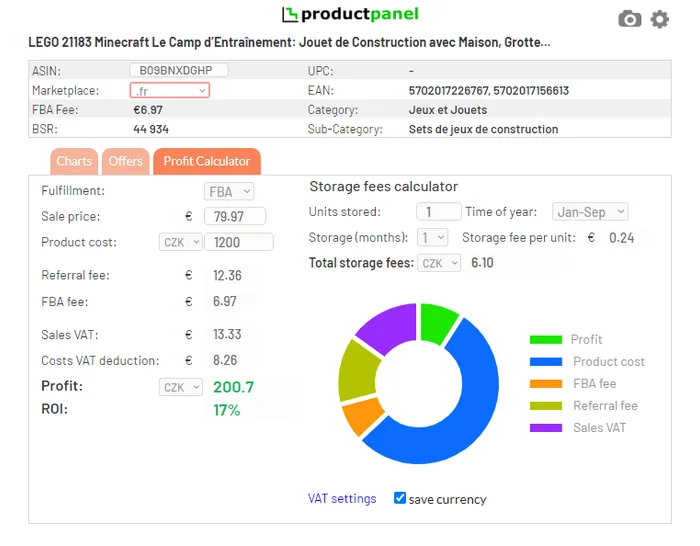
Amazon FBA storage fees – FAQ
How are Amazon FBA storage fees calculated?
Storage fee = average daily units stored × cubic feet per unit × monthly rate. Cubic feet = length × width × height in inches ÷ 1,728 (or in centimetres ÷ 28,317). The rate depends on the size tier (standard-size or oversize), the month (January–September or October–December) and, for older stock, how long the units have been stored.
What are Amazon FBA storage fees in 2026?
In the US, standard-size products cost $0.78 per cubic foot per month from January to September and $2.40 from October to December. Oversize products cost $0.56 and $1.40. In the UK, standard-size products cost £0.76 and £1.51, and oversize products £0.55 and £0.87 per cubic foot per month.
What are Q4 storage fees on Amazon?
From October to December Amazon charges peak storage rates: $2.40 per cubic foot for standard-size items in the US (about 3× the January–September rate) and £1.51 in the UK (about 2×). Fees are based on the average daily volume each month, so every unit still in storage during October–December is billed at the peak rate.
What changes in Amazon storage fees on February 1, 2027?
In the US, Amazon removes the storage utilization surcharge and the separate aged inventory surcharge and replaces them with one age-based monthly rate. Standard-size stock aged 0–180 days stays at $0.78 per cubic foot (January–September), but 181–270 days costs $2.78 and 271–365 days $6.68. From October to December $1.62 is added for standard-size and $0.84 for oversize.
What is the Amazon aged inventory surcharge (long-term storage fee)?
It is an extra monthly charge for units stored longer than 180 days in the US (240 days in the UK), assessed on the 15th of each month. In the US it ranges from $0.50 per cubic foot at 181–210 days to $7.90 per cubic foot (or $0.35 per unit, whichever is greater) after 455 days. From February 1, 2027 it is built into the age-based US rate.
What is the storage utilization surcharge?
An extra per-cubic-foot charge for Professional sellers whose storage utilization ratio (average daily inventory volume ÷ average daily shipped volume over 13 weeks, in weeks) is above 22 weeks. New sellers, Individual accounts and sellers storing 25 cubic feet or less are exempt. In the US it is removed from February 1, 2027.
Is this storage fee calculator exact?
It uses Amazon’s published rates for non-dangerous goods and assumes the same number of units stays in storage for the whole period. Your real bill depends on Amazon’s measured dimensions, daily average units and how stock ages as it sells. Use it to plan; check Seller Central for your final fees.
How can I reduce FBA storage fees?
Send smaller, more frequent shipments, avoid arriving with slow stock right before October, remove or liquidate units before they cross 180 days (US) or 240 days (UK), reduce packaging size, and keep an eye on sell-through with a BSR history chart before you reorder.
Sources
Rates for non-dangerous goods, verified November 9, 2026. Amazon may change fees at any time.